Complex healthcare decisions demand far more than isolated data points or the opinion of a single key opinion leader. True clinical strategy thrives at the messy intersection of raw evidence, frontline experience, and actual system constraints. At Remedium Healthcare, we engineered our advisory boards to power pharma, medtech, and health systems through these exact clinical challenges.1
Think of an advisory board as the critical bridge between a controlled clinical trial and real-world practice. We rely on these experts to stress-test data against the diverse realities of Indian patient populations, glaring resource gaps, and constantly shifting treatment paradigms.2,3
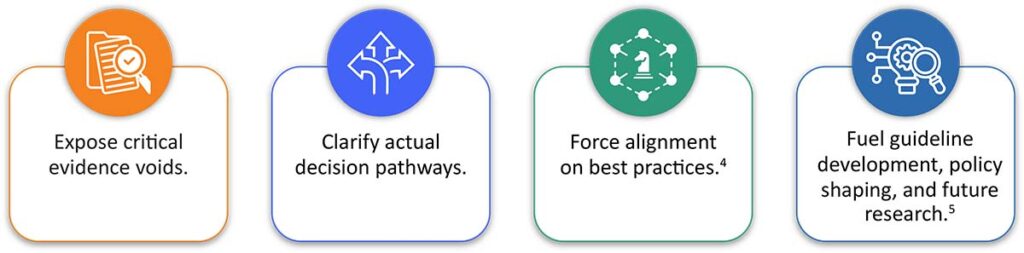
When structured correctly, these boards actively:
Without a rigid framework, however, hierarchy dominates the room. Our methodology ensures absolute scientific rigor.6
From Discussion to Consensus: The Delphi Evolution
The traditional Delphi technique uses iterative, anonymous surveys to forge an objective consensus, effectively neutralizing bias through aggregated feedback.1,6 However, Remedium’s Modified Delphi approach adapts this rigorous statistical model for the fast-paced environment of live advisory boards.2
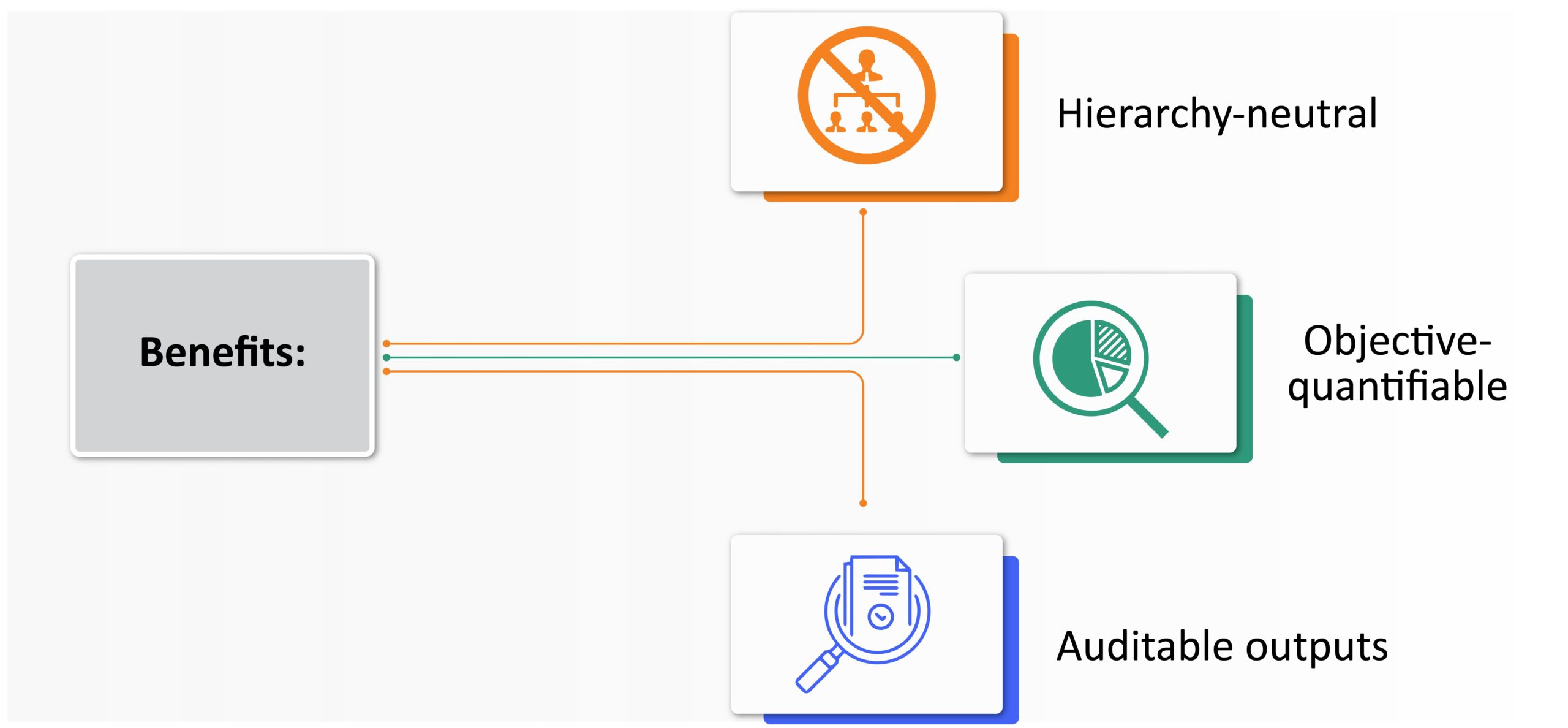
We front-load the process with comprehensive pre-meeting evidence packs and draft statements. Once in the live session, we run a strict tactical cycle: present the data, clarify nuances, vote anonymously, and instantly re-vote to hit our >75% consensus threshold.4 This hierarchy-neutral approach generates objective, quantifiable, and fully auditable outputs.
» Pre-meeting evidence packs and draft statements.
» In-session cycle:
Remedium's 4-Phase Execution Framework
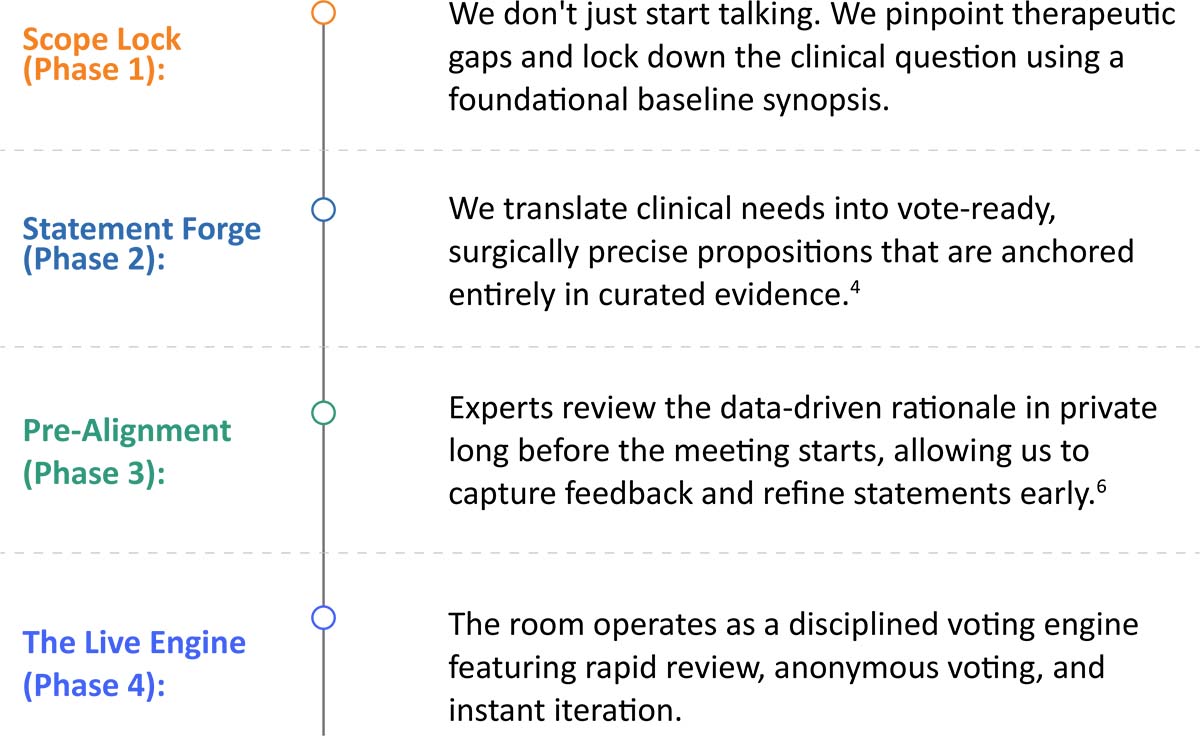
To guarantee reproducible results, our end-to-end framework operates across four disciplined phases:3,5
The Remedium Differentiator
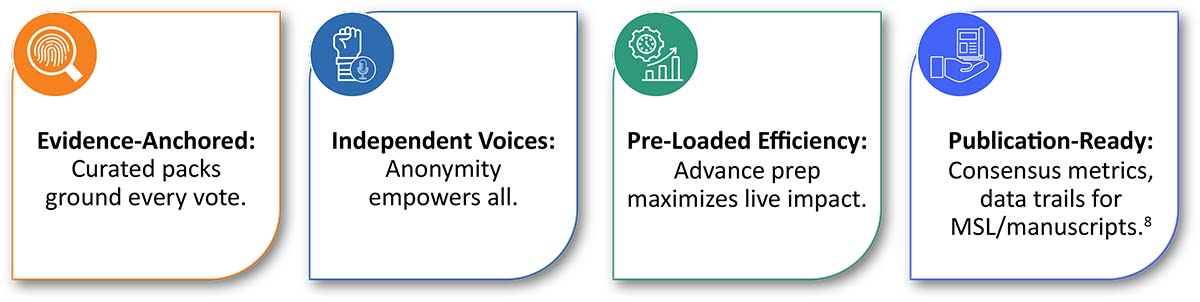
What truly sets our boards apart? We are unabashedly evidence-anchored, ensuring curated data packs ground every single vote. Our commitment to independent voices through anonymity empowers all participants and systematically reduces dominance bias, ensuring strong personalities cannot sway the group.6
By leaning heavily on pre-loaded efficiency and advance preparation, we maximize the impact of the live session. In fact, because our statements are pre-refined, we consistently achieve a remarkable 95–99% voting strike rate in live sessions. Finally, every outcome is publication-ready, generating hard consensus metrics and data trails that transition seamlessly into MSL resources and peer-reviewed manuscripts.4
Building a Structured Advisory Board Framework
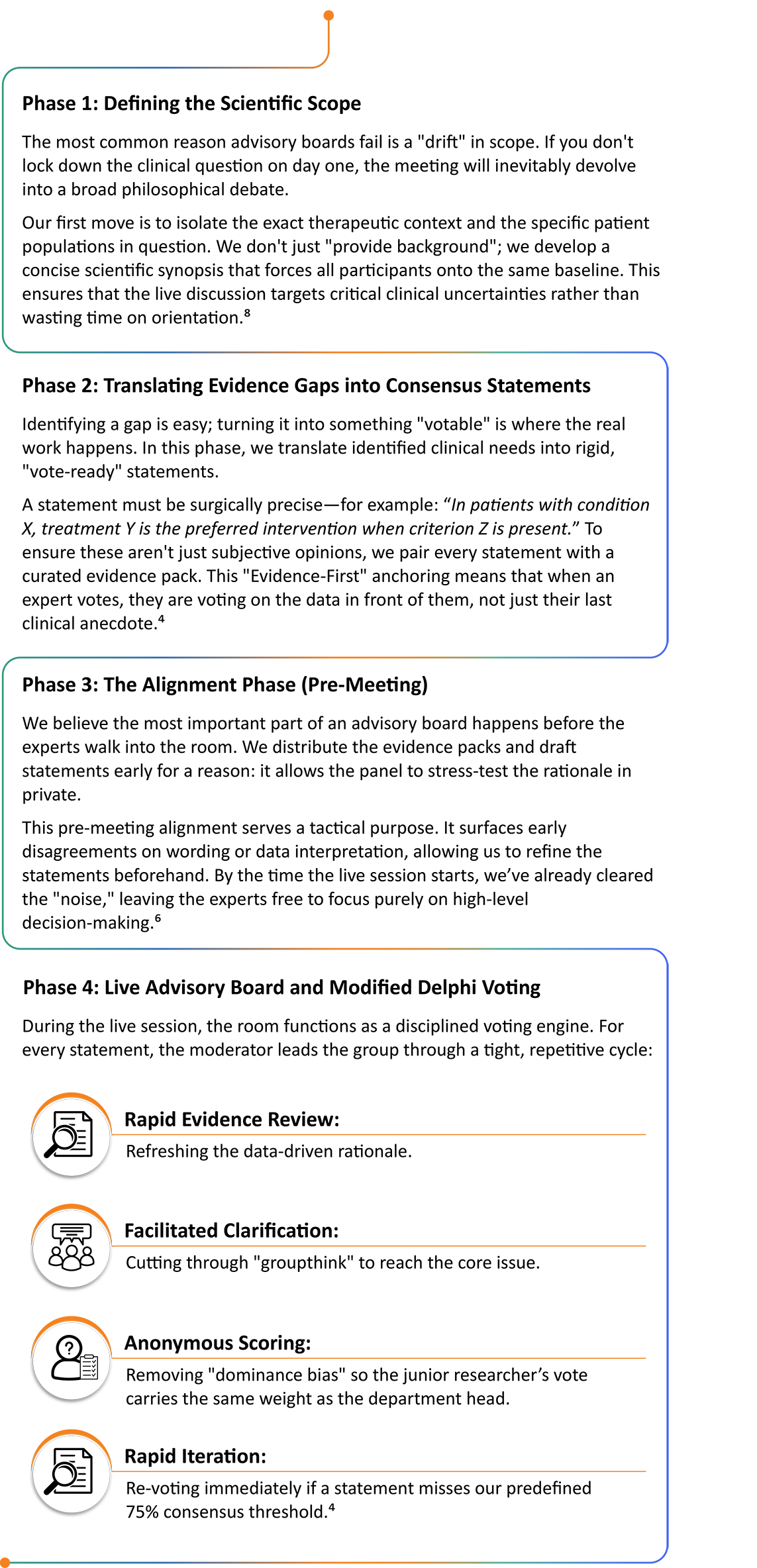
High-impact advisory boards don’t happen by accident. They are engineered. To move a group of diverse experts from a set of vague problems to a high-confidence, publication-ready consensus, we follow a disciplined, four-stage execution model.8
This structure guarantees that the final report isn’t just a summary of a chat – it is a defensible, auditable, and publication-ready evidence base.
What Makes a High-Impact Advisory Board
The reality is that many advisory boards are simply expensive conversations. To deliver a meaningful outcome, an ad-board must transition from an “opinion forum” to a “consensus engine.” We have found that several defining characteristics separate high-impact boards from the rest.
First, they are unapologetically evidence-driven. In a high-stakes clinical environment, expert opinion is only as good as the data supporting it. We anchor the discussion in a meticulously curated body of evidence, ensuring that insights are grounded in hard data rather than shifting clinical anecdotes.
Second, they prioritize independent judgment. A group of experts is only valuable if every voice is heard. By using anonymous voting mechanisms and Modified Delphi structures, we neutralize “dominance bias” and preserve the integrity of the consensus. This ensures that the final result isn’t just the opinion of the loudest person in the room, but the collective intellect of the entire panel.4
Third, they front-load the heavy lifting with intensive pre-meeting preparation. We don’t wait until the meeting starts to begin the work. By providing well-structured evidence packs and clearly articulated questions weeks in advance, we dramatically improve “voting confidence” and the overall efficiency of the live discussion.
Finally, they produce audit-ready outputs. A successful board doesn’t end with a “thank you” note; it ends with a defensible evidence base—including consensus statements, granular voting results, and supporting data—that can be transitioned directly into a manuscript, a regulatory filing, or a strategic roadmap.8
Hallmarks of Remedium Boards
The Future: Consensus Reimagined
Regulators and payers demand transparent, reproducible insights. Remedium’s Modified Delphi turns boards into defensible engines – primed for India’s medico-marketing and market access wins. Partner with us to convert expertise into enduring strategy.8
References:
1. Hsu CC, Sandford BA. The Delphi technique: Making sense of consensus. Practical Assessment, Research & Evaluation. 2007;12(10):1-8. doi: https://doi.org/10.7275/pdz9-th90 2. Keeney S, Hasson F, McKenna H. The Delphi Technique in Nursing and Health Research. Wiley-Blackwell; 2011. doi:10.1111/jocn.15462 3. Jorm AF. Using the Delphi expert consensus method in mental health research. Aust N Z J Psychiatry. 2015;49(10):887-897. doi:10.1016/S0020-7489(00)00044-4 4. Diamond IR, Grant RC, Feldman BM, et al. Defining consensus: A systematic review recommends methodologic criteria for reporting Delphi studies. J Clin Epidemiol. 2014;67(4):401-409. doi: 10.1016/j.jclinepi.2013.12.002 5. Murphy MK, Black NA, Lamping DL, et al. Consensus development methods and their use in clinical guideline development. Health Technol Assess. 1998;2(3):1-88. doi:10.3310/hta2030 6. Dalkey N, Helmer O. An experimental application of the Delphi method to the use of experts. Manage Sci. 1963;9(3):458-467. doi:10.1287/mnsc.9.3.458 7. Okoli C, Pawlowski SD. The Delphi method as a research tool: An example, design considerations and applications. Inf Manage. 2004;42(1):15-29. doi:10.1287/mnsc.9.3.458 8. Data on file. Remedium Healthcare. A Structured Evidence-Driven Approach to Advisory Boards: From Gap Identification to High-Confidence Expert Consensus. Internal presentation deck; 2026.